Categories
Baseball Covid MLB

MLB Suspends Wrong Guys

Major League Baseball hasn’t had a banner week, despite managing to open its shortened season three-plus months into a worldwide pandemic. The strategy of trying to play games while covid-19 cases and deaths continue to mount in the United States remains to be fully tested, but a major outbreak among the Miami Marlins forced games to be postponed and schedule shuffled.

The worst case scenario didn’t unfold, yet. There hasn’t been a player or coach to suffer severe illness from covid, and if other teams aren’t affected by the virus spreading, the protocols might even hold.

So while MLB waits for the tests to show if the damage has been contained, they found a way to remind us how much potential they still have to mess things up somehow. Today’s suspensions of Dodgers pitcher Joe Kelly for eight games and manager Dave Roberts for one game took a bad decision and compounded it with a worse one.

To recap, the league found that the Houston Astros cheated throughout their 2017 championship season, which culminated in a World Series victory over the Dodgers. MLB issued harsh punishments to the Astros’ front office and manager, one-year suspensions that essentially could end careers. 

But they promised all the players immunity in exchange for revealing the details of the cheating program. So no player received any kind of punishment, and the team kept its title. The Dodgers, among other teams, were decidedly less than thrilled with that outcome.

Cut to the much-delayed 2020 season, in which the Dodgers and Astros were not scheduled to face each other originally but had to under the new regionalized schedule that reduced travel. In Tuesday’s 6th inning, relief pitcher Kelly appeared to struggle with his control and threw several pitches that missed their targets. He threw a few pitches that came close to hitting Astros but didn’t, and he also threw a few that didn’t come close to anything.


Let’s note this is the same Joe Kelly whose April video on Twitter showed him breaking windows in his house because his backyard pitching was so inaccurate. Do we know if he was just wild or if he intended to put a scare into the Astros? No. Did he hit anyone? No. Did he come really close to ending anyone’s career? No again.

So of course MLB slapped him with a suspension for 13% of the season, something totally out of proportion with the alleged crime. A few years ago Kelly was suspended for hitting a player with a pitch and then hitting him again in the ensuing brawl … and for that he received a six-game suspension. Hmmm.

Maybe you’ll recall in 1965 when the Giants’ Juan Marichal hit the Dodgers’ John Roseboro over the head with a bat? Marichal got 10 games for that.

Also, let’s remember once again that no Astro received as much as a single-game suspension for participating in a cheating scandal for at least a season. Does any of this feel appropriate?

Had Kelly actually hit anyone with a pitch or a fist or a piece of equipment, he would have earned a suspension. Maybe even a longer one. Kelly will appeal, the suspension will probably get cut down a few games, but no one will forget that MLB whiffed on this pitch and hit itself in the head in the process.
Categories
Baseball Covid MLB

MLB in Trouble Already

Well, that didn’t take long. After a weekend spent joyfully celebrating the return of baseball, Monday hit with a ton of reality bricks. 

The Miami Marlins have reportedly at least 12 players testing positive for Covid-19, plus some coaches. MLB stepped in and postponed the Marlins’ scheduled game in Miami against the Baltimore Orioles. And, since the Marlins’ positive tests occurred in Philadelphia (where they’d been playing the Phillies), MLB also postponed the New York Yankees’ game in Philadelphia.

The next 24-48 hours will give an indication of whether this is a hiccup or a collapsing season. If testing shows the impact has been contained, the Marlins can dip into their pool of 60 available players and resume playing once permitted. That’s why each team has a larger-than-usual 30-man active roster and 30 more available on short notice.

But it’s easy to see the whole house of cards falling down. Postponing more than a couple of games can create scheduling nightmares in a season with few off days already. Much worse, we could see an expanding outbreak that renders teams unable to play or facilities deemed unsafe. And that’s to say nothing of what might happen if someone were to become seriously ill.

This quote in The Athletic today speaks volumes about the situation:

“Major League Baseball needs to be thinking about the Phillies,” Dr. Zachary Binney, an epidemiologist at Emory University’s Oxford College, said Monday on The Athletic’s Starkville podcast. “They have conducted perhaps an inadvertent experiment, but an experiment nonetheless, on whether the virus can be transferred in a game from one team to their opponent. And we are awaiting the results of that experiment. We’ll see that in Philly, I think, over the next three to five days or so. But I think if you want to be cautious, you should probably be quarantining the Phillies as well for the next five days. And that’s extra rough for them because really, they didn’t do anything wrong. But again, it’s the virus that sets the agenda here, and you have to build your agenda around what it’s doing.”

Any sense that continuing to play cannot be achieved safely could start a ripple effect of players and other personnel opting out, and in a very short time the experiment could be over. How many players scheduled to take the field today might already be having second thoughts? “An inadvertent experiment” can’t be the words players want to read today.

Like many others, I got caught up in enjoying the games again the past few days. I started to believe this might just work, being an outdoor game with lots of space between players and precautions being taken. 

If this can’t work in today’s America, though, I can’t imagine how the NFL can pull it off this fall. And colleges? I doubt they ever take the field. Too many people in much too close quarters, way more so than baseball requires.

The NBA’s Orlando bubble experiment gets under way within the week, and though they seem to be taking strong measures to protect the players’ health, that could unravel just as quickly if anything goes wrong. 

Maybe sports is a luxury the U.S. just couldn’t manage because of how poorly we’ve handled containing the virus in comparison to the rest of the world. These restarts didn’t take place during a time when the cases were under control, but rather the opposite, during a spike. Maybe things can still work out, but we won’t have to look far for reasons why if they don’t.

Categories
Baseball Covid MLB

What Can Happen in a 60-Game Season?

Because baseball naturally lends itself to an obsession with numbers (and I cannot say for certain whether the game draws me to the stats, or vice versa), even non-fans tend to know the significance of certain milestones like hitting .400 or 60 home runs. As Major League Baseball begins its shortest scheduled season by far this week, announcers and writers have offered a variety of opinions on whether an individual achievement like hitting .400 would “count” in a 60-game season.

I think we can wait to see if anyone gets halfway through this season with a legitimate chance before devoting too much brainpower to that question, but I do think there is a number very much worth thinking about from the outset: 2.7. That’s the multiplier we get from the ratio between a full 162-game schedule and the 60-game Covid-shortened one, so essentially every game “counts” like 2.7 games normally would. Winning 3 in a row is the equivalent of winning 8 in a row in a full season, relatively.

We can use 2.7 to gauge what an outstanding individual performance might look like across 60 games. For instance, 20 home runs would equate to 54 in a full season. In 2019, when players collectively reached record-breaking totals yet again, the highest individual total was 53 by the Mets’ Pete Alonso

At the 60-game mark last season, the Dodgers’ Cody Bellinger had hit 20 and wasn’t close to leading the National League. The Brewers’ Christian Yelich already had 25! That’s a pace for 68 in a full season, but he missed 32 games and fell well short at 44.

So we shouldn’t be the least surprised to see someone get to 25 or even flirt with 30 in this short season, because it’s much less difficult to sustain that level of performance for a shorter time period. Hitting 60 homers in a season remains surprisingly rare and hasn’t been achieved since Barry Bonds hit a record 73 in 2001. 

(The 60-homer mark has only been reached eight times in MLB history, in fact. A particularly fun stat is that Sammy Sosa did it three times, more than anyone else, but he failed to lead his league any of those seasons. He finished behind Bonds in 2001 and Mark McGwire in 1998 and 1999. Should they ever re-open bars, you could probably win a good bet with that piece of trivia.)

While individual numbers will certainly catch our attention in this 60-game season, the standings could offer another place worth watching. Will any team win 40 games? Probably so. That’s a 108-win pace, and in the past two seasons three teams have won between 106 to 108 games. 

Don’t be stunned if a team wins as many as 45, though. In 2013, the Dodgers put together a 42-8 midseason stretch. The 1984 Tigers opened the season 35-5. We don’t have to look far for examples of what’s possible in a chunk of a season, which is what this really is.

A team could be equally bad, too. The 1988 Orioles started the season with a record 21-game losing streak. At the 60-game mark, they were just 15-45. The worst team in 2019, the Tigers, went 47-114, and in June and July they were a combined 10-40. They started a semi-respectable 22-33 and then went 25-81 the rest of the way, which would be a 14-win pace in a 60-game season.

Categories
Baseball MLB Sim Baseball

Bad Neighbor League

As I described in my previous post, I won my 23rd title in Sim League Baseball today. The theme for this league was one of my favorites and worthy of some extra footnotes.

The Bad Neighbor League included only MLB teams from 1922, 1932, 1942, 1952, 1962, 1972, and 1982. Owners have to build their 25-man rosters using players from four teams, using at least six players from each team. The catch is you only get to choose two of your teams, and two of your division mates (bad neighbors) get to stick you with bad ones.

As if that weren’t enough, your third division opponent gets to “dagger” any player on your four teams that you cannot use as well as one of the four ballparks you have available to you. Oh, and the roster restrictions and salary cap are very challenging, too. 

So when you’re building the team, you have to work around using a lot of players you don’t want to and fit them in with the ones you do want. It’s a real puzzle, and everyone ends up only partially happy with their team. 

After one of my division mates “gifted” me the 1972 Texas Rangers, who were managed to a 54-100 season by Hall of Famer Ted Williams, I commented that based on the woeful hitting of that team Williams probably spent the season in the dugout daydreaming about his famous hobby, fishing. So of course I had to name the team, Ted Williams Would Rather Be Fishing.

One of my team’s heroes turned out to be a somewhat unlikely contender, considering he cost only about $1 million out of the $80 million allotted. One of the joys of games like this is expanding my knowledge of baseball history and its players, because no matter how long I keep at this I’ll be encountering players I didn’t know.

Frank Biscan pitched for the St. Louis Browns in 1942, 1946, and 1948, totalling only 148 career innings. He was a relief pitcher in an era when that role went to failed starters, a far cry from the specialized role it plays in today’s MLB. In 1942, the season I used, Biscan appeared 11 times for 27 innings and posted a 2.33 ERA. Since the cutoff for having your season used in the sim is 25 innings, the left-hander barely made it.

I installed Biscan as my closer, and he delivered a near-perfect season. He made 36 appearances for me and earned 35 saves in his first 35 tries. Only in his final game did he blow a save, but the team rallied so he earned the victory. Then in the playoffs, Biscan went 7 for 7 in saves, including 3 games in the World Series. He might well have been my MVP.

Another interesting note about Ted Williams Would Rather Be Fishing while I’m at it. The League Championship Series went a full 7 games, and in the deciding game my leadoff batter Wally Judnich of the 1942 Browns hit a home run to start the bottom of the 1st inning. Our ace pitcher, Johnny Vander Meer (most famous for throwing back-to-back no-hitters in 1938, a feat never duplicated), pitched 8 shutout innings, and Biscan finished it off for a 1-0 series-clinching victory.

Cut to the first game of the World Series. Once again, Judnich led off the bottom of the 1st inning with a home run. And once again that was the only run of a 1-0 victory. The odds against winning back-to-back games in that nearly identical fashion, let alone critical playoff games, must be astronomical. As I posted in the league forum, Holy deja vu, Batman!

One of the discoveries you make after thousands of simulated seasons is that you are actually observing many more games than have ever actually been played in the real MLB, so when something really rare pops up it has a great deal to do with quantity. Play enough games, and some remarkable achievements and unusual performances will surely arrive at some point. 

Categories
Baseball Jack Bauer Squared MLB Music Sim Baseball

What’s In a Name?

Why is this team called Jack Bauer Squared? I shouldn’t assume the references make sense to everyone.

The unique structure of this particular theme league called for owners to draft exactly one player from each of 24 franchises and disperse them across a 24-year span from 1969 to 1992. This meant that you could not have two players from, say, 1988. Nor could you have two players from the Dodgers or Yankees or anyone else. Only the “original” 24 franchises, meaning those in the major leagues as of 1969, were eligible, so it excluded the Colorado Rockies, Arizona Diamondbacks, Miami Marlins, Tampa Bay Rays, Toronto Blue Jays, and Seattle Mariners.

The draft was therefore called 24×24 to represent that each owner had to fill 24 franchise spots and 24 years to complete their roster. The 25th and final player was selected in a supplemental round consisting only of players from the six later franchises and from the years 1993-2019.

For those who were not watching television in the 00s, Jack Bauer was the name of the lead character in the Fox show 24, which followed a counter terrorism agent through a 24-hour cycle of events each season, divided into 24 one-hour episodes designed to appear as if they occurred in real time. 

One other owner took the 24×24 very literally and named his team “576.” My favorite names are “24 Lines About 24 Players,” a very clever song reference, and “A Rod, some Wood and a Big Unit,” playing off the names of three of his draftees whose names and nicknames have something distinctly in common with something totally different. 

Shoutout also must go to “P Niek! At the Disco” for combining a key player (Phil Niekro), music from the era, and a band reference. The owner also placed his team in Chicago’s Comiskey Park, famous for the 1979 promotional disaster Disco Demolition Night, so major bonus points for that.

Categories
Baseball Covid MLB

Ready or Not, Here Comes MLB

As I launch this blog and get my first set of posts out there, I am watching the Los Angeles Dodgers play a “Summer Camp” game at Dodger Stadium against the Arizona Diamondbacks. The Dodgers have pummeled the Diamondbacks two games in a row and look ready for Thursday’s much-delayed Opening Day.

As much as the game on the field looks like the real thing, everywhere are reminders that what is taking place is as much surreality as reality. Instead of fans in the seats there are cardboard cutout pictures of fans. (I would buy one, but only if I could get my Angels fan coworker on there in a Dodgers hat and a shirt that read “Astros Cheat!” I doubt they’d allow it, and good luck getting him to wear the hat anyway.)

MLB scrapped the original start of the season when Covid-19 started to spread dangerously in March, and teams all suspended their spring training just a couple weeks before the scheduled season openers. That week when one sport after another postponed or canceled games, tournaments, and seasons, all the way up to the Olympic Games, resembled nothing in history. Sports sections shrank to nothing practically overnight.

Much of baseball’s time since was spent with players and owners making news for their inability to agree on the financial terms of playing, and their tone-deaf squabbles cost fans the chance to see more games than we’re scheduled to get now. Massive labor issues remain to be resolved in the long run, but we’ll have time to lament the chasm between the sides after this mini-season wraps up.

A 60-game season represents only 37% of a normal 162-game schedule, so little margin for error remains. Losing 3 games in a row in 2020 would be like losing 8 in a row in any other season. Debate has already started about whether any historically significant statistical performances, like someone batting .400 (which hasn’t been accomplished since 1941), would count in a shorter season.

The much larger question we should all be asking, however, is whether any of this is a good idea. Unlike in the NBA’s “bubble” environment in Orlando, Florida, MLB teams will be traveling from city to city and playing in their home stadiums throughout the 60-game season.  

All this will launch while the United States watches Covid-19 cases mount and mount and hospitals nationwide begin to feel the crunch of being overwhelmed by ill patients requiring critical care. Across the country, cities and states are closing back down to keep as many people home as possible, and just now MLB is attempting to open operations in many of these hotspots. The government of Canada won’t let the Toronto Blue Jays play at home because of mandatory quarantine requirements for anyone entering the country, so a few days before the season starts the Jays have yet to find a temporary home.

We can legitimately ask what might halt this 60-game season (plus the all-important playoffs) before its scheduled finish. A handful of players have already opted out for health reasons, and several more have yet to join their teams because of positive tests. It’s easy to imagine a significant group of players on one team testing positive and having to miss a significant chunk of this short season, with dramatic impact on the standings. How many teams would have to suffer such challenges before many more players drop out or teams find themselves unable to field a healthy roster?

It is all much too surreal. These guys on TV look like they are playing baseball, but it feels like they’re playing a much more dangerous game. 

Categories
Baseball Covid Jack Bauer Squared MLB Sim Baseball

Selecting a Stadium

Sim baseball schedules rarely fit the travel-based logic of professional teams, so you don’t generally play extended road trips or homestands unless the game was specifically programmed to create that added verisimilitude. My teams in WIS do, however, each play in a specific real-life ballpark with effects on games based on the dimensions and actual historical performance in those parks.

There are well over 100 stadium choices in the game. They range from historical fields from the early days of baseball with only guesses at some of the details lost to time, to every stadium in current use. You’ll find the most offense-friendly parks in history, Denver’s Mile High Stadium and Coors Field, to the pitchers’ favorites, the Houston Astrodome and San Diego’s Petco Park.

For this 24×24 league, no owners can have the same ballpark, and we were restricted to those actually called someone’s home from 1969 to 1992. Part of our draft included selecting our unique ballpark in any round we chose. I waited until near the end to try to find the best fit for the team I’d built.

Sometimes the strengths of a team lend themselves to a particular park, especially if you are trying to hit a lot of home runs — or, more importantly, prevent them. Some owners put less stock in the importance of a park and select more neutral choices frequently, and when a team doesn’t have an obvious strength you want to exploit, that’s a sensible way to go.

I wound up in Montreal’s Olympic Stadium for this league for a handful of reasons, which may or may not prove wise as the season progresses. I’ll get into the sim reasons once I’ve explained park effects better, but the best non-sim reason for the choice is that earlier in 2020 (just before everything started shutting down due to coronavirus) I made my first visit to Montreal. The stadium is still there, but the baseball team is long gone. 

The Expos relocated to become the Washington Nationals in 2005, and in 2019 they won the franchise’s first World Series in its 51st season. From 1969 to 2004, the Expos only made the playoffs one time, in 1981. They had the league’s best record going in 1994 when a strike ended the season prematurely, so we’ll never know what they might have accomplished were it not for the first season to end without a World Series since 1904. 

Categories
Baseball MLB Sim Baseball

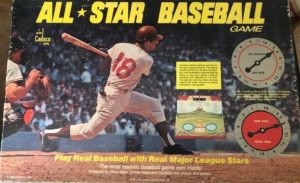
All-Star Baseball

Fresh from my garage, my original All-Star Baseball game is still ready to play.

Among the many sports simulation board games still housed in my garage is the original and best-selling All-Star Baseball. Designed by a former major league player and coach, Ethan Allen, and first released in 1941, All-Star Baseball reigned as the ultimate baseball sim for decades.

I can’t trace my first encounter with ASB precisely, but I know I played solitaire and head-to-head games with friends often. The game’s simplicity was critical to its success, even if it overlooked tremendously important aspects of baseball. Everything was reduced to the batter, and the cards realistically simulated the percentage of times a real player did certain things like hit a home run, strike out, or walk. 

ASB cards were discs with numbers around the edges that represented different outcomes in proper proportions. Results were revealed by a spinner that would stop and point to the play’s result. New card sets would come out after each season, and there were also all-time greats available. I remember learning the names of some baseball legends from playing the game.

The version in my garage probably dates to about 1979 or 1980, based on the player cards in there. It was last played close to 20 years ago, as I can tell from one of the simple scorecards included in the set, when I challenged my stepson to a couple games when trying to teach him more about baseball. He beat me, 10-9, so you can tell I wasn’t cheating!

Categories
Baseball Covid MLB Sim Baseball

Here Come the Seasons

July 18, 2020

The season will start tonight, shortly after 10 pm where I live. I’m writing the season narrative as it unfolds, so this could turn into a description of a championship season or the struggles of an also-ran team. Starting off with a team I already had success with and then going back and writing about it would have been cheating. 

Does this raise the stakes a bit? Sure. Do I wish I’d decided to do this before I started drafting the team in the first place? Sure. But does life normally come at you with direct plans that work perfectly? As in baseball, the unpredictable happens.

Five days from now, Major League Baseball plans to start an abbreviated 60-game season that will run roughly parallel with this sim season about to unfold. Our simulated season will play three games a day for 54 days to reach a full 162-game season, starting July 19 and finishing on September 10, followed by a few days of playoffs. 

MLB will attempt a Covid-shortened schedule from July 23 to September 27, followed by a month or so of playoffs, if all goes well. A lot has to go well, too. The sports world, like the one at large, looks drastically different in 2020. The only place nothing has changed is here on the computer, where games go on unhindered 365 days a year.